Apple Search Ads: Stop Bidding on Installs
Apple Ads (formerly Apple Search Ads) bills per tap, but most teams still grade it on cost-per-install, which optimizes for cheap installs instead of users worth paying for. The fix is to bid toward predicted lifetime value: feed post-install revenue signals back, group keywords by intent, set a target ROAS instead of a target CPI, and derive your ceiling from your own unit economics (target CAC = LTV divided by target ROAS). Teams that make this shift stop overpaying for users who never convert and put budget behind the ones who do.
The default Apple Ads setup quietly optimizes for the wrong thing. Apple renamed Apple Search Ads to Apple Ads in April 2025 as its inventory grew beyond App Store search, but the old trap survived the rebrand: campaigns chase cheap installs, reward the keywords that produce the most taps, and leave you proud of a low cost-per-install while your revenue flatlines. The cheapest user and the most valuable user are almost never the same person. Here is how to stop bidding on installs and start bidding on value.
Key takeaways
- Cost-per-install rewards volume, not value. Optimizing to CPI points your spend at the cheapest taps, which is rarely the same as finding buyers.
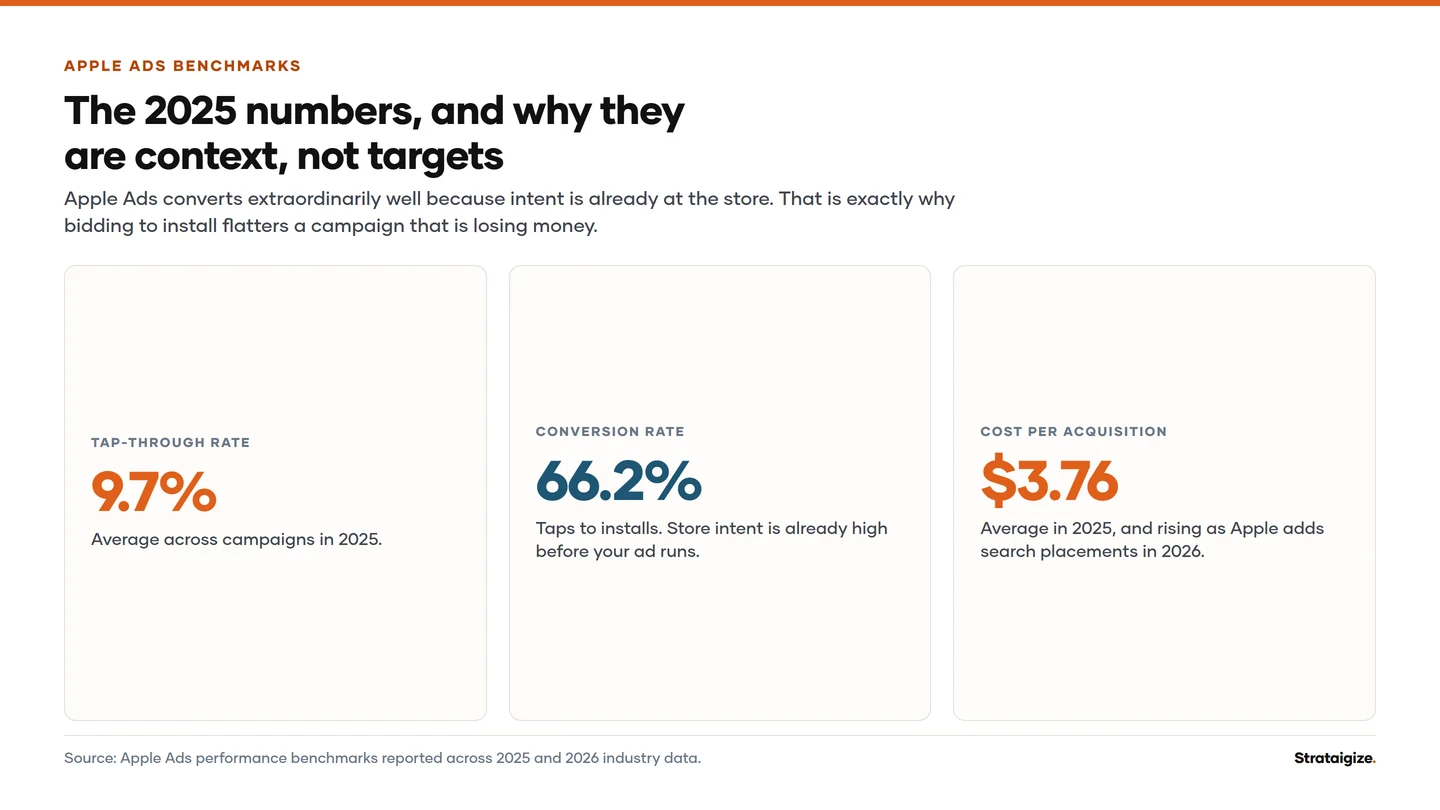
- The benchmarks are context, not targets. In 2025 the average tap-through rate was 9.7% and the average conversion rate was 66.2%, but a “good” cost is the one your own LTV can support.
- Your real CPI ceiling comes from your economics, not an industry chart. Target CAC equals lifetime value divided by your target ROAS, your CPI ceiling is that CAC times your install-to-payer rate, and a healthy LTV to CAC ratio is roughly 3 to 1 or better.
- iOS measurement is coarse by design. SKAdNetwork and AdAttributionKit hand you privacy-thresholded conversion values, not user-level revenue, so you optimize on modeled value, not perfect attribution.
- The auction keeps getting more crowded. Average cost-per-acquisition reached $3.76 in 2025, and Apple began rolling out multiple ad placements in search results in 2026, so the teams that win are the ones optimizing for value before competition bids costs higher.
Why installs are the wrong number to optimize
Installs are the easiest number to move and the easiest to fool yourself with, which is exactly why they make a bad optimization target. When you grade Apple Ads on cost-per-install, every decision that follows (bids, keywords, budgets) chases the people most likely to tap and install cheaply. Nothing in that objective asks whether those people ever open the app twice, start a trial, or pay.
The result is a campaign that looks efficient and performs poorly. You can drive your CPI down by 30% and watch revenue stay flat, because you simply bought a cheaper, worse cohort. This is the core trap of vanity metrics: the number improves while the business does not.
The fix is to change the question. Instead of “how cheaply can I get an install,” ask “how much is this user worth, and what can I afford to pay for them.” That single shift, from volume to value, is what predicted-LTV bidding is built to answer, and it is the difference between a UA program that scales profitably and one that just spends.
The 2026 Apple Ads benchmarks you actually need
Use benchmarks to sanity-check your funnel, never as a target to hit, because the right number is the one your unit economics can support. With that caveat front and center, here is where Apple Ads sat heading into 2026.
On engagement, the average tap-through rate for search results campaigns was 9.7% in 2025, per SplitMetrics’ Apple Ads benchmark report. Conversion from tap to install is unusually strong on the channel, averaging 66.2% in the same dataset, because someone searching the App Store is already in a buying posture.
On cost, the spread is enormous, which is the whole point. AppTweak’s Apple Ads benchmarks put the global median cost-per-tap near $0.92 as of late 2025, the US median around $1.91, and the median cost-per-install for search results campaigns near $1.80, while SplitMetrics measured the average cost-per-acquisition at $3.76 for 2025. High-LTV categories like finance routinely pay several times those medians. And remember what the bill actually meters, as SplitMetrics’ cost guide lays out: you pay per tap in a second-price auction, so installs are an outcome you optimize toward, not the thing you directly buy.
Read those ranges and the lesson is obvious: a $4 CPI is a disaster for a hyper-casual game and a steal for a wealth-management app. The benchmark tells you nothing until you put your own LTV next to it.
Know what you are buying, too. Apple Ads runs across four App Store placements: the Today tab, the Search tab, search results, and product pages while browsing. Search results ads can be paired with custom product pages so the landing experience matches keyword intent, and Apple began expanding search results to multiple ad placements in 2026, which raises the stakes on deliberate bidding.
What predicted-LTV bidding actually means
Predicted-LTV bidding feeds the ad platform an estimate of each prospective user’s value, so the auction optimizes toward revenue instead of raw installs. Rather than telling Apple “get me installs under $2,” you tell it “get me users whose modeled value clears my ROAS goal,” and let it bid up for the valuable ones and away from the rest.
The mechanics, as Admiral Media lays out, come down to three moves: switch the objective from volume to value optimization or target ROAS, set a defensible ROAS goal grounded in your margins, and stop reading CPI as your success metric. The platform will happily pay more for a user it predicts is worth $80 and refuse to overpay for one worth $2. That is the entire advantage.
This is also why the profitability math is simple once you frame it right. Your target CPI is not a number you copy from a benchmark, it is a number you derive: target CAC equals lifetime value divided by your target ROAS, and your CPI ceiling is that CAC times your install-to-payer rate. A healthy program aims for an LTV to CAC ratio of about 3 to 1 or better, so every dollar of acquisition returns at least three. Get those inputs right and the bid takes care of itself.
How to move Apple Ads to LTV bidding
You move to LTV bidding in four steps, in order, because each one feeds the next. Skip the groundwork and the platform has nothing valuable to optimize toward.
First, feed post-install signals back into the account. The platform can only optimize for value if it sees value, so connect the events that predict revenue: trial starts, subscriptions, key activations. Second, group keywords by intent, not by volume. High-intent branded and category terms behave nothing like broad discovery terms, and blending them hides which dollars actually convert. Third, set a target ROAS, not a target CPI, anchored to the CAC math above; in Apple Ads Advanced that means deriving your max cost-per-tap bids and CPA goals from value, not from a benchmark chart. Fourth, shift budget toward the keyword groups that produce paying, retained users, and starve the ones that produce cheap installs and nothing else.
None of this is exotic, but the order matters. Most teams jump straight to step four, reallocating budget, without doing the measurement work in step one, and then wonder why the platform keeps serving them cheap, worthless taps. Value in, value out.
The measurement problem on iOS, and how to work with it
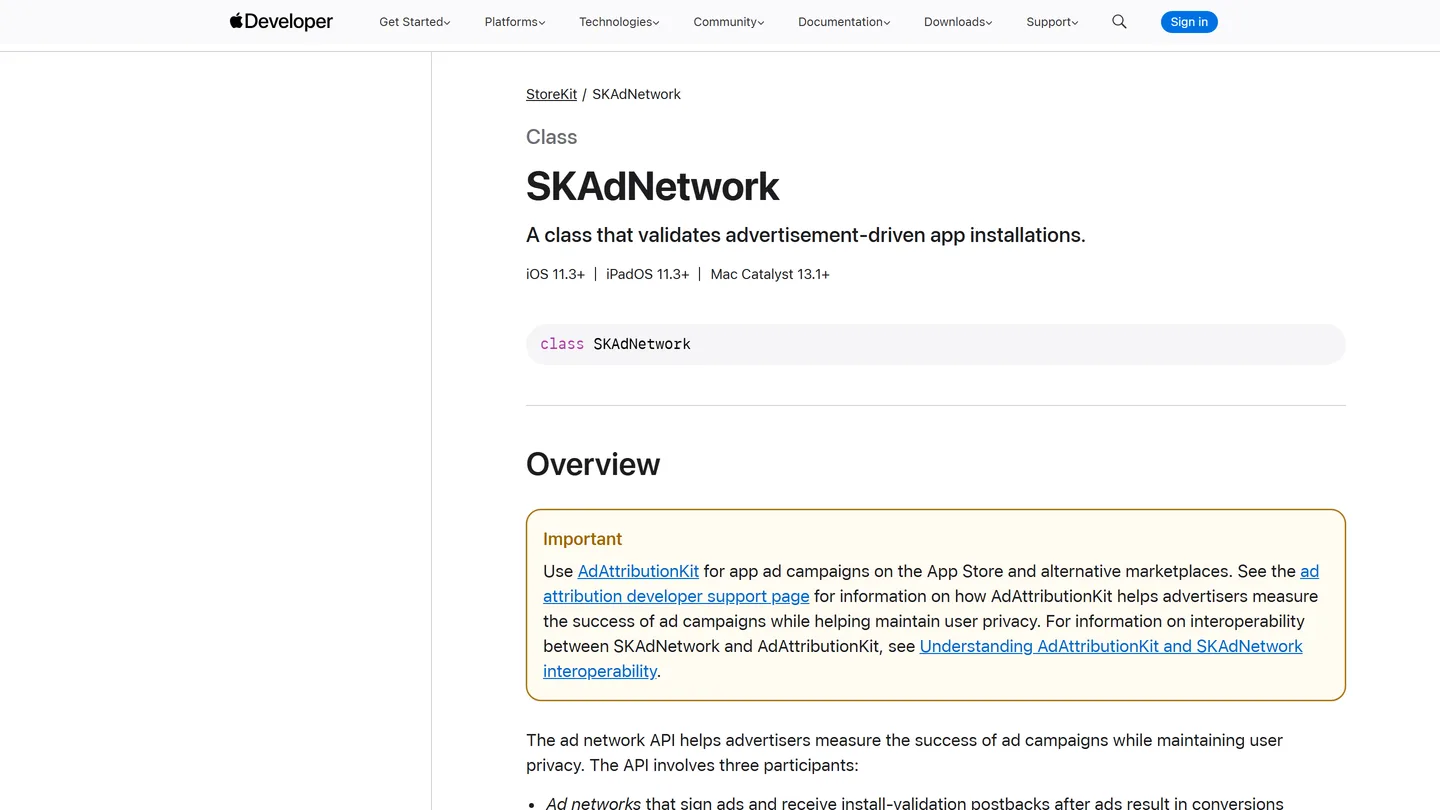
You cannot get clean user-level revenue on iOS, so you optimize on modeled value and stop chasing perfect attribution. Apple’s privacy framework compresses conversions into coarse, thresholded postbacks. As measurement guides on SKAdNetwork 4 explain, you receive privacy-protected conversion values rather than a tidy revenue figure tied to each user, and in 2026 AdAttributionKit is the primary framework to design against, with SKAdNetwork postbacks still flowing alongside it through the transition.
That sounds like a reason to give up on value-based bidding. It is the opposite. Because the signal is coarse, the teams that win are the ones who design their conversion-value schema deliberately: mapping the limited value buckets to the post-install actions that best predict LTV, so even a blurry signal points in the right direction. A well-designed conversion value that flags “started trial” beats a perfect attribution model you do not have.
The practical takeaway: treat iOS measurement as a modeling problem, not an accounting one. You are not trying to trace every dollar. You are trying to teach a privacy-limited system to recognize a valuable user, then letting it bid accordingly. If you want the bigger picture on how this fits the attribution stack, our explainer on what a mobile measurement partner does is a useful next read.
A worked example: setting your real CPI ceiling
The formula only clicks when you watch it run on one app, so here is the whole method end to end. Say your subscription app earns about $30 in lifetime value per paying user over six months, after refunds and churn. You decide you want a 3 to 1 return, so you are willing to spend at most a third of that value to acquire a customer: a maximum CAC of $10.
Here is the step everyone skips. CAC is not CPI. If 25% of your installs become payers, then your cost-per-install ceiling is your max CAC times that conversion rate, $10 times 0.25, which is $2.50 per install. That is your real CPI ceiling, derived from your economics. It might land near the market medians by coincidence, but you arrived at it through your numbers, not someone else’s chart.
Now watch why the cheap install loses. Imagine one keyword group delivers installs at $1.50, but those users convert at only 10%, so its true CAC is $15, above your $10 ceiling, and it quietly loses money on every cohort. A second group costs $3.00 per install, looks expensive, but converts at 40%, so its CAC is $7.50 and it prints profit. Optimize on CPI and you would pour budget into the first group and choke the second. Optimize on value and you do the opposite. That reversal, the cheap keyword bleeding you while the expensive one pays, is the entire case for bidding on LTV in one example.
Common Apple Ads mistakes
The most expensive Apple Ads mistake is celebrating a falling CPI without checking what those installs are worth. A 30% cheaper install that never converts is not a win, it is a faster way to lose money.
The next most common is benchmarking against industry CPI instead of your own LTV, which leads apps to either overpay or starve perfectly profitable keywords. Third is dumping branded, category, and discovery keywords into one campaign, so the cheap branded taps mask how badly the discovery terms perform. Fourth is leaving the conversion-value schema on its default, throwing away the one lever you have to teach iOS what a good user looks like. Last is treating the account as set-and-forget while auction prices drift and Apple ships new placements underneath you.
How we run Apple Ads
We run Apple Ads as a value-acquisition channel, not an install machine, which means the measurement and economics come before the bids. Our paid acquisition program starts by mapping your LTV by cohort and designing the conversion-value schema, then groups keywords by intent and optimizes to ROAS, so spend follows the users who actually pay.
It is the same discipline that produced real results. In our work with the family app Podz, tightening acquisition cut cost-per-install by 65% while scaling installs roughly ninefold, because we optimized for the right users instead of the cheapest ones. Strong acquisition also leans on a strong store listing, which is why we pair it with app store optimization rather than treating them as separate jobs. If you want to see where your own Apple Ads spend leaks first, a growth audit will map it against your real unit economics.
FAQ
Is a low cost-per-install good?
Only if those installs are worth more than you paid. A low CPI that produces users who never convert is worse than a higher CPI that produces buyers. Judge cost against lifetime value and ROAS, not against an industry average.
What is a good cost-per-install on Apple Ads?
There is no universal number. As of 2026, the median CPI for search results campaigns sits near $1.80 and the average cost-per-acquisition ran $3.76 in 2025, but high-LTV categories like finance pay several times that and are still profitable. Your real ceiling is your target CAC (LTV divided by target ROAS) times your install-to-payer rate.
What is predicted-LTV bidding?
It is bidding toward the modeled lifetime value of each prospective user rather than toward raw installs. You feed revenue signals back, set a target ROAS, and let the platform pay more for valuable users and less for cheap ones.
Can I do LTV bidding with iOS privacy restrictions?
Yes. SKAdNetwork and AdAttributionKit give coarse, privacy-thresholded conversion values rather than user-level revenue, so you optimize on a well-designed conversion-value schema that maps the limited buckets to the actions that predict LTV. A deliberate schema beats perfect attribution you cannot have.
How is CAC different from CPI?
CPI is the cost of an install. CAC is the cost of acquiring a paying customer, which folds in conversion and retention. Optimizing CPI can quietly raise your real CAC if the cheap installs do not convert, which is the whole reason to bid on value.
How long does it take to see results from LTV bidding?
Expect a few weeks for the platform to gather enough value signal to optimize, longer if your conversion events are sparse. The slowest part is usually the measurement setup, not the bidding itself, which is why we do that groundwork first.