Top 7 RevenueCat Alternatives for SaaS & App Monetization
The strongest RevenueCat alternatives in 2026 are Adapty, Superwall, Qonversion, and Purchasely for mobile in-app subscriptions, plus Chargebee, Recurly, and Paddle for SaaS and web billing. Teams usually switch for lower fees at scale, deeper paywall A/B testing, or merchant-of-record billing. Most mobile-first options now start free and charge a small percentage of tracked revenue as you grow.
What Is RevenueCat and Why Look for Alternatives?
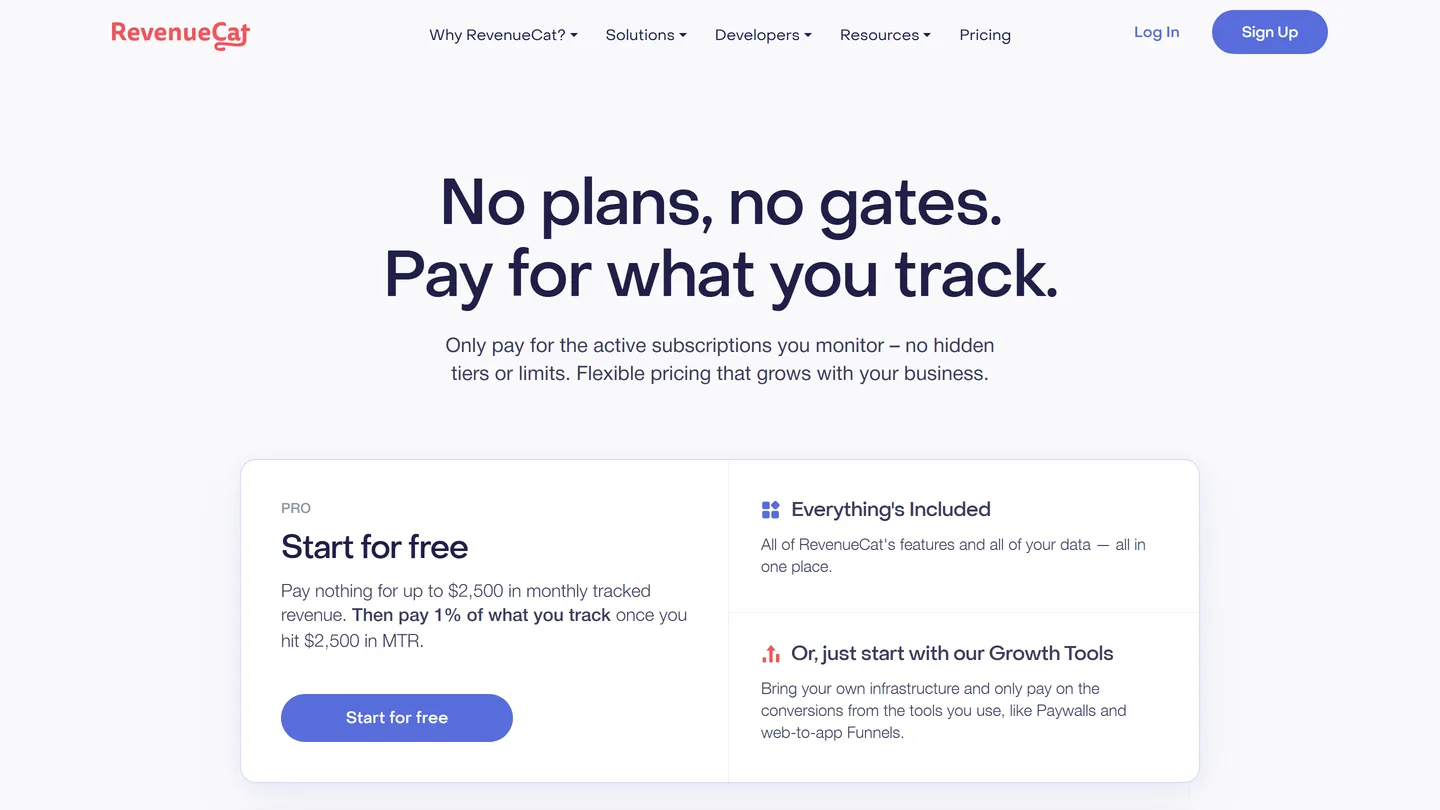
RevenueCat is the default subscription infrastructure for thousands of mobile apps. It wraps in-app purchases, receipt validation, entitlements, and subscription analytics into one SDK for iOS and Android. RevenueCat’s pricing is free up to $2,500 in monthly tracked revenue (MTR), after which the Pro plan charges 1% of tracked revenue, with custom Enterprise plans above that (as of August 2026). Keep in mind that MTR is gross store revenue, counted before Apple or Google take their commission.
That 1% feels small until it compounds. An app tracking $500,000 a month hands over $5,000 every month for infrastructure it may have outgrown. Beyond price, teams switch because they need deeper paywall experimentation, more customization, stronger web and SaaS billing, or a merchant of record that handles global sales tax for them.
Consider the key factors when looking for alternatives:
- Pricing model and how it scales with your revenue
- Paywall building and A/B testing depth
- Analytics, attribution, and integration options
- Web, desktop, and cross-platform billing support
- Global payment, tax, and compliance coverage
With numerous options available, there’s likely a platform that fits your specific needs. The right choice depends on where your revenue actually flows: through the app stores, through the web, or both.
RevenueCat vs. the Alternatives: 2026 Comparison
We compared each platform on the factors that actually move subscription revenue: mobile IAP support, paywall experimentation depth, and what it costs at your scale.
| Tool | Best for | Mobile IAP | Paywalls & A/B testing | Pricing (as of August 2026) |
|---|---|---|---|---|
| RevenueCat | Default subscription infrastructure for mobile apps | Yes (unified SDK, receipt validation) | Native paywalls and experiments | Free to $2.5K MTR, then 1% of tracked revenue |
| Adapty | Paywall experimentation and conversion optimization | Yes | Native builder with strong A/B testing | Free under $5K MTR, then 1% of revenue |
| Superwall | Rapid paywall iteration | Yes (infrastructure added in late 2025) | Deepest pure paywall testing | Free to $10K monthly attributed revenue, then usage tiers |
| Qonversion | End-to-end subscription growth stack | Yes | Advanced paywalls and experiments | Free to $10K MTR, then 0.6% to 0.8% of revenue |
| Purchasely | Enterprise in-app journey personalization | Yes | No-code paywalls, onboarding, win-back flows | Quote-based |
| Chargebee | Subscription billing for SaaS | Not native | Limited, relies on external tools | Free Starter tier, then plans from $599/mo |
| Recurly | Enterprise-grade recurring billing | Not native | No built-in paywalls | Monthly fee plus 0.9% of billing volume |
| Paddle | Merchant-of-record billing and tax compliance | No mobile IAP | Checkout experiments | 5% + $0.50 per transaction |
One note before the deep dives: if you are migrating from Glassfy, it is no longer an option. Glassfy ceased operations on December 31, 2024 and stopped onboarding new customers, publishing migration guides to RevenueCat, Adapty, and Qonversion on its way out. We dropped it, along with other stalled tools, from this year’s list.
Key Features to Consider in Subscription Management Tools
When evaluating subscription management tools, some features are crucial for optimal performance. The right platform should align with your business requirements.
First, consider user interface and ease of use. A complicated interface can slow down operations and impact user experience. A simple, intuitive design is ideal for managing subscriptions effectively.
Next, look at analytics and reporting features. Comprehensive insights help track performance and guide strategic decisions. Strong reporting capabilities allow you to optimize monetization efforts.
Seamless integration is another key factor. The tool should work well with existing systems and tech stacks. Flexibility in integration can reduce migration headaches.
If you’re tying subscription revenue back to paid acquisition, use this Appsflyer integration guide to improve campaign measurement and optimization.
Here are some features to look for:
- Robust analytics and reporting
- Easy user interface
- Flexible integration options
- Custom pricing models
- Global payment support
Considering these features ensures the tool supports your growth and revenue strategies. Evaluate options carefully to choose the best fit. A tailored solution can significantly enhance your subscription management capabilities.
Whichever tool you use, cross-platform data alignment is critical, our security app case study is a detailed example of what happens when RevenueCat and Google Ads report different purchase signals, and how we fixed it to unlock real revenue growth.
Top RevenueCat Alternatives for Mobile App Monetization and SaaS Billing
Finding the right RevenueCat alternative requires considering diverse features. Each tool offers unique strengths for mobile app monetization. The best choice depends on your specific needs and business model.
Effective subscription management is key for SaaS billing platforms too. With the right tools, managing recurring payments becomes seamless. Let’s explore the top alternatives to RevenueCat, tailored for mobile app and SaaS revenue generation.
1. Adapty
Adapty stands out for its paywall builder and experimentation speed. You can design, target, and A/B test paywalls remotely without shipping app updates, which is where most subscription revenue gains actually come from.
In February 2026, Adapty reworked its pricing: the Pro plan is now free under $5,000 in monthly tracked revenue, then 1% of revenue, and the old $99 per month minimum is gone. Enterprise plans are custom.
Key features of Adapty include:
- No-code paywall builder with remote configuration
- A/B testing for paywalls and pricing
- Predictive analytics and LTV forecasting
- Seamless integration with iOS and Android
If you plan to test paywalls, start from a baseline: our paywall conversion benchmarks show what good numbers look like before you iterate.
2. Superwall
Superwall is the paywall specialist. It began as an A/B testing layer that sat on top of tools like RevenueCat, then expanded into full subscription infrastructure in late 2025, so you can now run purchases, entitlements, and analytics on Superwall alone.
Its pricing is unusual in a good way: Superwall bills on Monthly Attributed Revenue, meaning only revenue generated through its paywalls counts, and it is free up to $10,000 MAR (as of August 2026).
Key features of Superwall include:
- Hundreds of templated, remotely editable paywalls
- Granular experiments on price, copy, and design
- Pricing tied to attributed revenue, not all revenue
3. Qonversion
Qonversion offers a full subscription growth stack: infrastructure, no-code paywalls, experiments, and revenue analytics in one place. Integrations with major analytics and attribution platforms keep your acquisition data connected.
Qonversion’s pricing is free up to $10,000 MTR, then Starter at 0.6% and Growth at 0.8% of tracked revenue, with custom Enterprise plans (as of August 2026). Those percentages undercut both RevenueCat and Adapty at scale.
Key features of Qonversion include:
- Easy in-app subscription management
- Real-time revenue tracking and cohort analytics
- A/B experiments for paywalls, prices, and onboarding
4. Purchasely
Purchasely positions itself as an in-app experience platform rather than a billing SDK. Teams at apps like Headspace, Le Monde, and The Times use it to build and test paywalls, onboarding, and win-back journeys without code.
It is the most enterprise-leaning mobile option on this list. Purchasely does not publish pricing; plans are quote-based through a sales demo (as of August 2026).
Key features of Purchasely include:
- No-code paywall, onboarding, and win-back builders
- Audience targeting across the whole user lifecycle
- Enterprise-grade security and compliance
5. Chargebee
Chargebee excels in handling complex billing scenarios. This platform is great for SaaS providers needing detailed invoicing options. It supports multiple pricing strategies and seamless global transactions, but it does not manage native mobile in-app purchases.
Chargebee’s pricing starts with a free Starter tier that covers early billing volume, with the Performance plan at $599 per month plus 0.75% overage fees beyond plan limits, and custom Enterprise pricing (as of 2026).
Key features of Chargebee include:
- Multi-currency support
- Custom billing cycles
- Robust invoicing system
6. Recurly
Recurly specializes in managing complex subscription billing needs. It’s designed for businesses seeking automation and customization, supports numerous billing models, and its integration capabilities streamline processes.
Recurly’s pricing pairs a monthly platform fee with 0.9% of billing volume beyond your included allowance, and larger volumes move to custom pricing (as of 2026).
Key features of Recurly include:
- Automated billing workflows
- Advanced analytics and reporting
- Support for multiple payment gateways
7. Paddle
Paddle simplifies global sales for SaaS, web, and desktop products by acting as your merchant of record. It handles payments, sales tax, and invoicing under its own entity, so you never have to register for VAT in dozens of countries.
Paddle’s pricing is a flat 5% + $0.50 per successful transaction (as of 2026). There is no mobile in-app purchase support, which makes it a complement to a mobile IAP stack rather than a replacement.
Key features of Paddle include:
- Integrated payment processing
- Comprehensive tax management as merchant of record
- Seamless subscription billing for web and desktop
How to Choose the Right Subscription Management Platform
Choosing the right platform involves assessing business needs and technical requirements. Consider what features are vital for your app or SaaS product.
Start with where your revenue lives. If it is mostly App Store and Google Play subscriptions, shortlist Adapty, Superwall, and Qonversion against RevenueCat. If it is web-first SaaS revenue, compare Chargebee, Recurly, and Paddle instead.
Then evaluate platforms on specific criteria. Look at ease of use, scalability, and customer support. Ensure the platform aligns with your growth plans.
Key factors to consider:
- Feature compatibility with your app
- Integration with existing tools
- Pricing model and effective cost at your revenue level
- Support for global currencies, taxes, and payments
Make an informed decision by comparing how platforms measure up against your business objectives. This ensures long-term success and efficient subscription management.
FAQ
Is RevenueCat free to use?
Yes, up to a point. RevenueCat’s free tier covers your first $2,500 in monthly tracked revenue, and the Pro plan then charges 1% of tracked revenue (as of August 2026). Because tracked revenue is measured before store commissions, model the effective fee against your net revenue before committing.
Is Glassfy still a RevenueCat alternative?
No. Glassfy announced in mid-2024 that it was winding down and shut down on December 31, 2024. It no longer onboards customers, and its official migration guides pointed users to RevenueCat, Adapty, and Qonversion.
Which RevenueCat alternative is best for paywall A/B testing?
Adapty and Superwall are the two strongest options. Superwall is the deepest pure paywall experimentation tool and only bills on revenue its paywalls generate, while Adapty pairs strong testing with broader analytics and LTV forecasting.
Can Chargebee, Recurly, or Paddle replace RevenueCat for a mobile app?
Not for native in-app purchases. Apple and Google require most digital goods sold inside apps to run through their billing systems, and these three platforms are built for web, SaaS, and desktop billing. Many app companies run one of them for web checkout alongside a mobile IAP platform.
Final Thoughts: Maximizing Mobile App Monetization and SaaS Revenue
In a competitive market, selecting the right tools is crucial. Efficient subscription management can significantly boost revenue and operational efficiency.
Exploring RevenueCat alternatives helps you find tools tailored to your specific needs. Prioritize flexibility, integration, and reliable support to maximize growth potential.
Understanding your business goals and customer base will guide you in choosing the perfect platform for successful app monetization and SaaS billing.
If you want hands-on help connecting acquisition, attribution, and subscription growth, explore our mobile app marketing services.