Sensor Tower Review 2026: Features, Pricing, and Use Cases
Sensor Tower is the dominant mobile market intelligence platform in 2026. After acquiring rival data.ai in March 2024, it folded both datasets into one platform covering app performance, usage, advertising, audience, gaming, and web insights. Pricing is quote-based and annual: benchmark data puts most contracts between $30,000 and $150,000 per year as of early 2026, and a limited free tier still exists. We use it for competitor benchmarking, market sizing, and UA and ASO research.
Sensor Tower is a mobile and digital market intelligence platform covering app store performance, advertising, and usage data, now consolidated with data.ai after the March 2024 acquisition. As of 2026, pricing is quote-only with no published list price, and the only credible order-of-magnitude signal on record describes licences with “price tags upwards of tens of thousands of dollars” per year (TechCrunch, March 18, 2024). Its download and revenue figures are modeled estimates, strongest for top-ranked apps in large markets and weaker in the long tail. A limited free account still exists.
What Changed Since Our Last Update
- We removed the “median contract of about $74,415” figure. Vendr’s public Sensor Tower marketplace page no longer publishes a median, and it now states plainly that there is no standard list pricing and that quotes vary by module, coverage, seats, and term. We also dropped the specific discount percentages we previously cited, because we cannot verify them against a current primary or transaction source.
- We reviewed the entry-price and contract-band figures circulating on smaller SEO and affiliate blogs during 2026 and left every one of them out of this update. None could be traced to a primary source, a vendor statement, or a verifiable transaction dataset, and several contradicted each other by an order of magnitude. The only pricing anchors in this review are now the vendor’s own materials, software directories that state what the vendor does and does not disclose, and TechCrunch’s reporting at the time of the acquisition.
- We added the Sensor Tower MCP Server, shipped in 2026, and the gating detail that it requires an active API subscription (Sensor Tower, 2026).
- We added the 2026 Pathmatics roadmap: a Linear TV channel spanning more than 120 TV networks and 6,000 programs, plus expansion into Argentina, Colombia, Ireland, and Kakao in South Korea (Sensor Tower product year in review, 2026).
- We replaced the customer testimonial block with a comparison against AppTweak, App Radar, and Singular, which is what buyers at this stage actually need.
What Sensor Tower Is in 2026
Sensor Tower sells estimates. It combines app store data with a global first-party consumer panel to model downloads, revenue, revenue per download, active users, sessions, time spent, keyword rankings, ratings, reviews, and ad share of voice (sensortower.com, 2026). You license it to answer questions your own analytics cannot: how big is this category in Japan, who is outspending us on TikTok, what is a good day-30 retention curve for a puzzle game.
The competitive picture is settled. Sensor Tower acquired data.ai, formerly App Annie, in March 2024 for an undisclosed amount, backed by credit financing from Bain Capital and investment from Riverwood Capital and Paramark Ventures (TechCrunch, March 18, 2024). data.ai carried roughly $100 million in annual recurring revenue at the time and had raised $157 million against Sensor Tower’s $46 million. Sensor Tower absorbed part of the 400-person team alongside a workforce reduction.
Both platforms were meant to run standalone “for now” at announcement. That ended. The data.ai brand is retired, its datasets were folded into Sensor Tower through 2025, and the give-to-get ConnectPlus free tier disappeared when accounts migrated, as we documented in our data.ai breakdown. Pathmatics, acquired in 2021, remains the engine behind the non-mobile ad intelligence.
Feature Breakdown
One naming warning before you read vendor pages or procurement listings. Sensor Tower’s own product pages and its 2026 MCP announcement use names like App Performance and App Advertising, while software directories and reseller pages still describe four legacy platforms: App Intelligence, Store Intelligence, Ad Intelligence, and Usage Intelligence (OMR, 2026). They are the same underlying modules. Confirm on the order form which ones you are actually licensing, because they are priced separately.
Store and App Performance
Downloads, revenue, RPD, keyword rankings, ratings and reviews, and search ads across the App Store and Google Play. This is the module almost every contract includes, and it is what powers competitive benchmarking and ASO keyword research.
Advertising Intelligence and Pathmatics
Share of voice across mobile ad networks, top advertisers and publishers, and creative libraries. Pathmatics extends this past mobile UA into social, display, video, and OTT. The 2026 roadmap adds a Linear TV channel covering more than 120 networks tied to over 6,000 programs, plus new country coverage in Argentina, Colombia, and Ireland and Kakao inventory in South Korea (Sensor Tower, 2026).
Usage Intelligence
Active users, sessions per user, time spent, and retention trends from the panel. This is the module that gained the most from the data.ai merger, since both companies ran independent panels.
GameIQ
Game-specific classification by sub-genre, product model, art style, and monetization, with metrics like ARPDAU (sensortower.com, 2026). If you publish games, this is usually the deciding feature versus cheaper ASO tools, none of which taxonomize games at this depth.
Sense AI and the MCP Server
Sense AI arrived in 2025 as natural-language navigation, so you can type “top puzzle games in Japan” instead of building a filter set. In 2026 it generates full reports from a prompt, with an executive summary, key insights, charts, and source citations (Sensor Tower, July 2026). The MCP Server followed in 2026, letting Claude, ChatGPT, or a custom LLM query App Advertising, App Performance, and Pathmatics data directly. Note the gate: it is available only to customers with an active API subscription (Sensor Tower, 2026).
Pricing: What Is Public and What Is Quote-Only
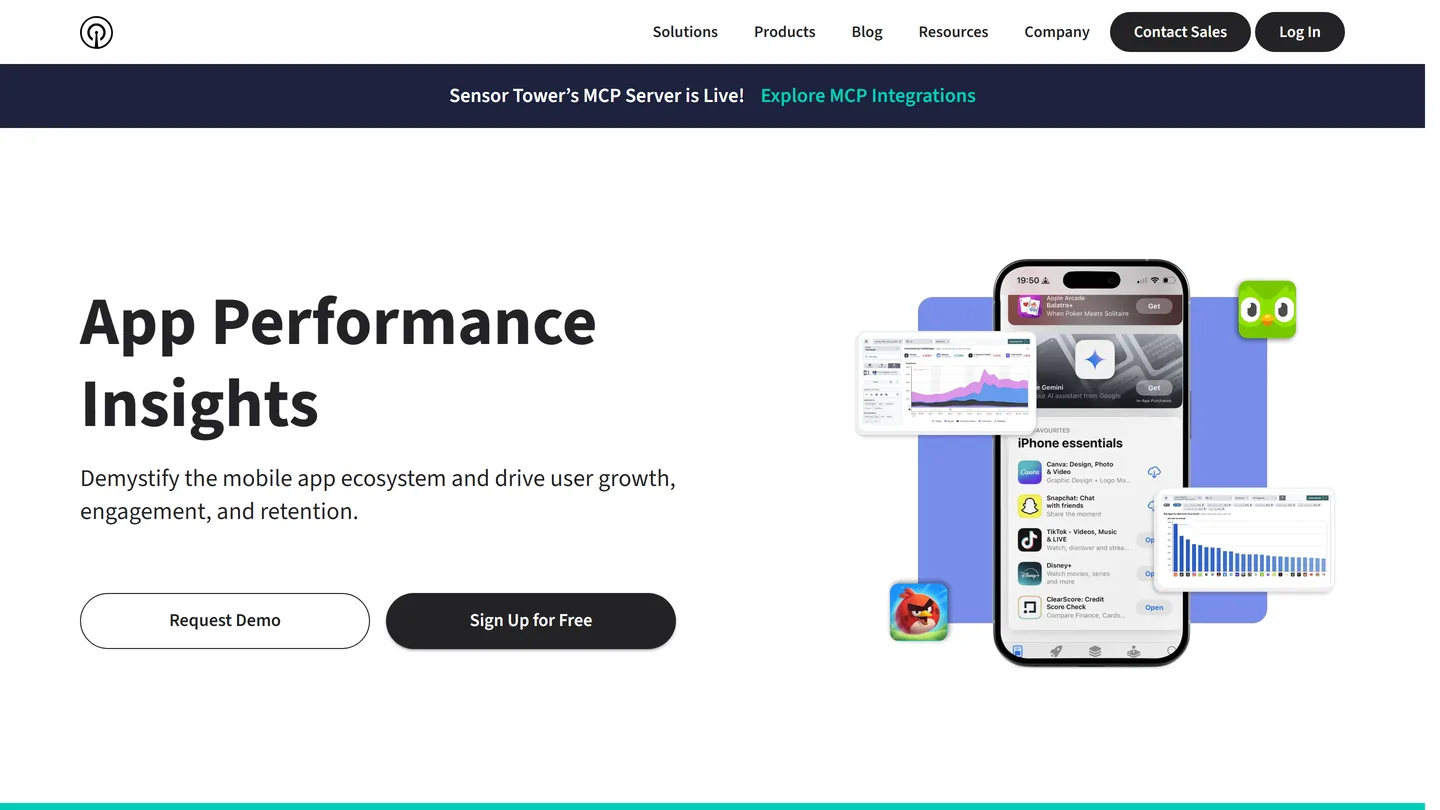
No number is public. Sensor Tower publishes no plan tiers, no self-serve monthly price, and no API rate card; every route to a figure ends at a sales form. Software directories confirm it: “the provider does not communicate any price information” (OMR, 2026). Vendr’s marketplace listing says the same in procurement terms, noting there is no standard list pricing and that every quote is scoped (Vendr, 2026). Contracts are annual subscriptions, a model Sensor Tower described in its own acquisition materials (BIIA, March 2024).
Here is every pricing signal we are willing to stand behind. Note what is missing: we deliberately excluded the specific contract bands and entry prices circulating on small blogs this year, because none of them can be traced to a primary source or a verifiable transaction dataset.
| Signal | What we can verify | Source and date |
|---|---|---|
| Published list price | None. The provider communicates no price information at all | OMR, 2026 |
| Standard pricing | No standard list pricing. Quotes are scoped per customer | Vendr, 2026 |
| Order of magnitude | Licences carry “price tags upwards of tens of thousands of dollars” | TechCrunch, March 18, 2024 |
| Contract model | Annual subscription | BIIA, March 2024 |
| Modules | Priced separately and licensed individually | OMR, 2026 |
| API | No published rate card. Quoted inside the same sales process, and required for the MCP Server | Sensor Tower, 2026 |
| Free account | Exists, covering top charts, category data, and app profiles at limited depth | Sensor Tower, 2026 |
| Free trial | None. Access starts with a sales conversation | Vendr, 2026 |
The honest summary is that anyone quoting you a precise Sensor Tower price without showing you a contract is guessing. The one durable anchor is TechCrunch’s characterisation at the acquisition: both Sensor Tower and data.ai commanded price tags upwards of tens of thousands of dollars. Treat the low five figures as the practical starting point for a scope that is genuinely usable, and expect multi-module, multi-market, deep-history deals to run considerably higher.
Your quote moves on five variables (Vendr, 2026): which modules you license, geographic and category coverage, historical depth, seat count and seat type, and contract length. Every path runs through a sales call, and there is no free trial.
How Accurate Is Sensor Tower’s Estimate Data
Sensor Tower’s numbers are models, not ledgers. The platform derives estimated downloads and revenue from app store signals combined with its first-party panel, which is how it can report on apps it has no relationship with (Sensor Tower documentation, accessed 2026). That design has predictable consequences you should price into your decision:
- Accuracy is highest for top-ranked apps in large, well-panelled markets, where sample size is deepest.
- Accuracy degrades in the long tail. An app with a few thousand monthly downloads may be off by a wide margin in either direction.
- Revenue estimates track store-processed transactions. Anything billed off-store, through the web, or through third-party payment flows sits outside the model, which matters more every year as subscription apps push checkout to the web.
- Post-merger, the panel is larger than either Sensor Tower’s or data.ai’s was alone, which mostly helps mid-tail coverage.
Use it for direction, share, and trend. Do not use it to reconcile your own revenue, and do not quote a competitor’s exact monthly figure to your board as fact.
Best Use Cases by Team Type
Across our aggregated Search Console data for this review and our other tool reviews, the queries that reach us cluster into three intents, in this order: cost, free access, and accuracy. Almost nobody arrives asking about features. That tells us buyers already know what the platform does and are trying to work out whether it is worth the line item. Mapping modules to jobs is how you answer that.
- User acquisition teams. Advertising Intelligence plus Pathmatics. You are buying competitor creative libraries, network share of voice, and spend estimates to decide where to test next. This is the module set with the clearest payback if you run meaningful paid budget.
- ASO teams. Store and App Performance. Keyword rankings, review mining, and category benchmarks. Also the module set where cheaper specialists compete hardest, which is why standalone ASO buyers rarely clear a Sensor Tower budget.
- Product and strategy. Usage Intelligence plus GameIQ. Retention and session benchmarks against category leaders, plus monetization model comparisons for games.
- Investors and corp dev. Cross-market App Performance with deep history. The demand here is coverage breadth, not creative detail, and the deals skew toward global data and API access.
Sensor Tower vs AppTweak, App Radar, and Singular
Two of these are alternatives. One is a different job entirely, and buyers confuse them constantly.
| Tool | Pricing model | Self-serve signup | Core strength | Best fit |
|---|---|---|---|---|
| Sensor Tower | Quote-only, annual, no list price (OMR, 2026) | No | Breadth: store, ad, usage, Pathmatics, GameIQ | Funded teams needing cross-market and omnichannel ad data |
| AppTweak | Published tiers, self-serve and annual options | Yes | ASO depth, keyword and creative workflows | ASO-led teams that want daily tooling, not board decks. See our AppTweak review |
| App Radar | Published tiers, lowest entry point of the three | Yes | Affordable ASO plus managed campaign options | Indie and small studio budgets. See our App Radar review |
| Singular | Quote-based, enterprise | No | Attribution and marketing data unification, not competitor estimates | Teams needing measurement, not market intelligence. See our Singular review |
The practical split: AppTweak and App Radar publish their prices and let you sign up today, so an ASO practitioner can be productive within an hour and inside a modest budget. Sensor Tower does neither, and charges an order of magnitude more, because it sells a different asset: modeled visibility into markets, competitors, and ad spend that no self-serve ASO tool matches. Singular sits in another category again. It measures your own spend and installs. It does not estimate anyone else’s, so pairing it with Sensor Tower is common rather than choosing between them.
FAQs
Is Sensor Tower free?
There is a limited free account covering top charts, basic category data, and app profiles with restricted history (Sensor Tower, 2026). It is useful for a one-off sanity check and useless for ongoing work. Everything else requires an annual contract, and there is no free trial (Vendr, 2026).
What happened to data.ai and App Annie?
App Annie rebranded to data.ai, Sensor Tower acquired data.ai in March 2024, and the brand is retired as of 2026 with its datasets folded into the Sensor Tower platform.
Does Sensor Tower publish an API price?
No. There is no published rate card, and the vendor communicates no price information for any part of the platform (OMR, 2026). API access is quoted inside the same sales process, and it is the prerequisite for the MCP Server (Sensor Tower, 2026).
Verdict: Who Should Buy and Who Should Skip
Buy if you run paid UA at scale, operate across multiple countries, publish games and need GameIQ taxonomy, or make market-entry and portfolio decisions where one good call is worth six figures. At that level, a licence priced in the tens of thousands of dollars or more is a rounding error against the budget it steers, and no competitor matches the combined store, usage, and omnichannel ad coverage post-merger.
Skip if your primary job is ASO on a single app, your annual tooling budget is under five figures, or you mostly need attribution rather than competitor estimates. TechCrunch’s “tens of thousands of dollars” framing tells you roughly where the line sits, and nothing the vendor publishes suggests it has moved down. Below that threshold, AppTweak or App Radar will do the daily work at a fraction of the cost, and Singular or another measurement platform covers your own numbers.
Negotiate hard if you are somewhere in between. Nothing about this pricing is fixed, and there is no list price to anchor against. Scope the modules you will actually open weekly, cut the geographies you do not sell in, cap the seats, and make the sales team quote each module separately so you can see what you are really paying for.
If you would rather have the insight than the invoice, our team runs ASO, user acquisition, retention, and reporting programs using this class of data on behalf of app publishers. Get in touch and we will tell you honestly whether a Sensor Tower license is worth it for your stage.