data.ai (formerly App Annie): Now Part of Sensor Tower
data.ai, the app intelligence platform formerly known as App Annie, no longer exists as a standalone product. Sensor Tower acquired it in March 2024, folded its data and features into the unified Sensor Tower platform, and retired the brand: data.ai's own website now simply announces the acquisition. If you are pricing app market intelligence in 2026, evaluate Sensor Tower and its alternatives instead. Here is what happened, what replaced each data.ai product, and how to buy smart.
What Happened to data.ai (formerly App Annie)?
For more than a decade, App Annie was the best-known name in app market intelligence: a public scoreboard for the app world that let companies see how competitors were performing without touching anyone’s private user data. Instead of guessing, teams could ask, “How many times was our rival’s new game downloaded in Brazil last month?” or “Are people spending more money in their shopping app than in ours?”
That kind of competitive data is valuable because it replaces gut feelings with fact-based decisions, and knowing what works for others (and what doesn’t) reduces expensive guesswork.
If you are searching for data.ai pricing, features, or a login in 2026, here is the short version: the product is gone, but the data lives on inside Sensor Tower.
The timeline:
- September 2021: The SEC charged App Annie and co-founder Bertrand Schmitt with securities fraud over how confidential customer data was used in estimates sold to trading firms. The company paid a $10 million civil penalty in the SEC’s first enforcement action against an alternative data provider.
- 2022: App Annie rebranded as data.ai.
- March 2024: Sensor Tower acquired data.ai. TechCrunch reported data.ai had roughly $100 million in annual recurring revenue at the time, and Sensor Tower absorbed part of its roughly 400-person team.
- Through 2025: Sensor Tower folded data.ai’s metrics and data science into its own platform and migrated customers to a single unified product.
- 2026: The brand is retired. Visit data.ai today and you get a login page with one banner: “We’ve Been Acquired by Sensor Tower.”
The core idea people loved about App Annie survives; you just get it from Sensor Tower now. If you are new to the category, this app intelligence tools guide breaks down what these platforms track and how teams use them.
What Happened to the Free Tier, data.ai ConnectPlus?
data.ai’s free product, ConnectPlus, ran on a “give-to-get” model: you connected your own app store accounts, contributed anonymized performance data to the pool, and received market benchmarks in return. It was a potluck dinner for app data, and for small teams it answered a genuinely useful question: “Is my app’s performance normal?”
ConnectPlus went away with the rest of the data.ai platform when accounts migrated to Sensor Tower.
The closest modern equivalent is a free Sensor Tower account, which covers basics like top charts and app profiles. It is thinner than ConnectPlus was, but it remains the zero-cost way to get a reality check on your category before paying for anything.
What Replaced data.ai’s Products?
Every data.ai capability now maps to a Sensor Tower module. If you had a data.ai contract, or you are reading old reviews, here is the translation as of 2026:
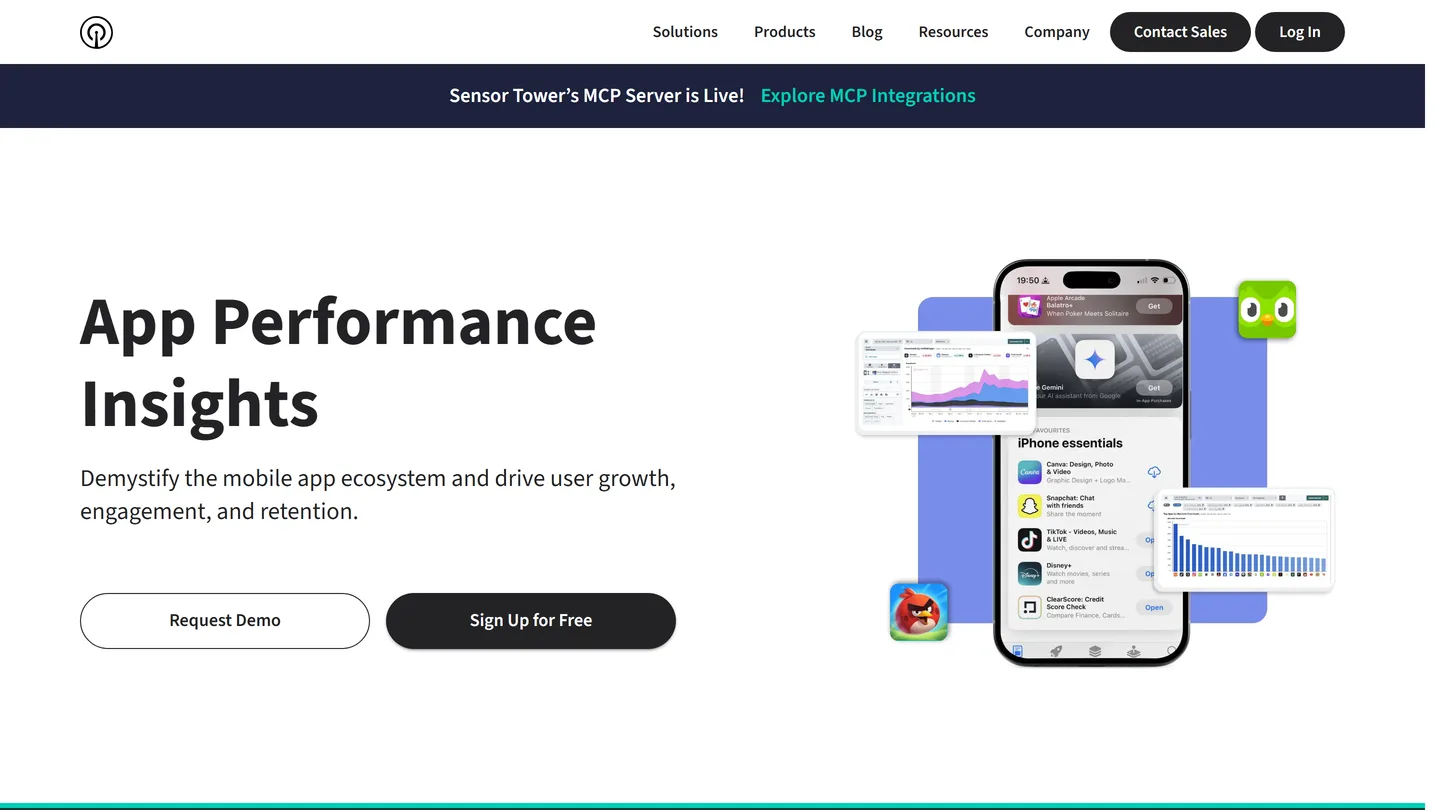
- data.ai Intelligence (download, revenue, and usage estimates) became Sensor Tower’s App Performance Insights and Advanced Usage Insights. The merged data science produced upgrades shipped through 2025: a revamped App Overlap report, Market Size, Install Base and Penetration, city-level Metro Usage, and more granular retention metrics, per Sensor Tower’s 2025 product review.
- data.ai Game IQ (game taxonomy and benchmarks) maps to Sensor Tower’s gaming insights and its GameIQ classification system.
- Advertising research maps to App Advertising Insights for mobile UA plus Pathmatics for omnichannel ad spend across Facebook, Instagram, TikTok, YouTube, OTT, and more.
- data.ai APIs and data feeds map to Sensor Tower’s APIs, plus a new MCP server (July 2026) that lets AI agents query the data directly.
data.ai Pricing Is Now Sensor Tower Pricing
data.ai never published list prices, and neither does Sensor Tower. The model that survives the merger is the same custom-quote structure data.ai used: the cost is built from the data modules you pick, the geographic scope you unlock, and the number of seats your team needs.
What has changed is that you can anchor expectations with benchmark data. According to Vendr’s transaction data, updated February 2026:
- The median Sensor Tower buyer pays about $74,415 per year
- Most contracts fall between $30,000 and $150,000 per year
- Small teams with 1-2 modules and limited coverage typically land around $30,000 to $70,000 per year
- Global enterprise deployments can exceed $250,000 per year
Before requesting a quote, simplify your needs. “I need to see game downloads in the U.S.” is a focused conversation. “Show me everything, everywhere” is a very large invoice.
data.ai vs. Sensor Tower: A Rivalry That No Longer Exists
This used to be the classic head-to-head. data.ai was the vast research library with deep historical data; Sensor Tower was praised for its modern, intuitive interface. Smart buyers got quotes from both and played them against each other.
That playbook is dead. You cannot get a competing quote from data.ai, because it is the same company, and one practical consequence of the merger is that buyers lost their best source of negotiating leverage in the category.
If you want leverage or a different price point in 2026, compare Sensor Tower against the platforms that are still independent:
- Apptopia, which tends to bundle more features into base pricing, per Vendr’s comparison data
- Similarweb, which trades some mobile depth for combined web and app intelligence
- AppMagic, MobileAction, and Appfigures, lighter-weight options worth quoting for smaller budgets
For the full picture of the consolidated platform, read our Sensor Tower review covering features, pricing, and use cases before you request quotes.
Is App Intelligence Worth It for a Small Business or Solo Developer?
For a solo developer or a small business, the full enterprise suite is still overkill, and the entry math has not changed just because the brand did.
Start free. A no-cost Sensor Tower account gives you top charts and basic app profiles, enough for a first reality check on your category.
The switch to a paid plan becomes a smart investment at a specific turning point: when the cost of guessing wrong exceeds the cost of the tool. Imagine you are about to spend $5,000 on a marketing campaign. If it fails because you targeted the wrong country or misread your competitors, the entire budget is gone. Paying a fraction of that for intelligence that prevents the mistake stops being an expense and starts being insurance.
Run the same thought exercise we use with clients: add up one month of your time plus your ad spend. If a subscription is a small fraction of that total but would measurably improve your decisions, it pays for itself.
Your Next Step: How to Think About App Intelligence Pricing in 2026
The old App Annie pricing model taught the right lesson, and it still applies now that the product lives inside Sensor Tower: you are not buying software, you are buying clarity. The cost depends on how much of the app world you need to see, and in how much detail.
The most powerful step you can take is not to guess at a price but to define your problem clearly. Before seeking a quote, get specific by answering a few simple questions.
Your 3-Question Checklist Before Seeking a Quote:
- What is the #1 business question I need to answer?
- Which single competitor’s strategy do I need to understand most?
- Which country is my most important market right now?
Answering these shifts your focus from “How much does it cost?” to “What clarity is worth paying for?” With that lens, data.ai pricing, in its new Sensor Tower form, becomes much easier to evaluate.
FAQs
What was data.ai (formerly App Annie) used for?
data.ai estimated app downloads, revenue, engagement, and category trends so companies could benchmark competitors and size markets. Those capabilities now live inside the Sensor Tower platform.
Can I still buy data.ai?
No. Sensor Tower acquired data.ai in March 2024 and retired the standalone product, and the data.ai website now points visitors to Sensor Tower. Buying “data.ai” in 2026 means buying Sensor Tower.
What replaced data.ai ConnectPlus?
The free give-to-get tier disappeared with the platform. The closest equivalent today is a free Sensor Tower account with limited top charts and app profile data.
Is data.ai better than Sensor Tower?
The question is obsolete: they are the same company, and data.ai’s datasets were folded into Sensor Tower through 2025. Compare Sensor Tower against independent alternatives like Apptopia, Similarweb, AppMagic, MobileAction, or Appfigures instead.
How can Strataigize help if we don’t want an enterprise license?
We run competitor and market research, build insight dashboards, and translate findings into an actionable ASO and paid growth plan, without you managing the tooling. Start with our mobile app marketing services.
Want App Intelligence Turned Into Growth?
Strataigize helps you translate market data into a clear plan for ASO, paid acquisition, and go-to-market, including competitor benchmarking, category opportunity mapping, and reporting you can act on.
Contact Strataigize today!